Friday, January 29, 2010

Watch For Wingtips

Get in late, get out early.

No, that's not my plan for attending my neighbor kid's piano recital.

It is a simple, yet awesome, piece of advice I got once for making your scenes (and your novel) hum right along:

Get in late
Start each scene at the latest possible moment you can to avoid unnecessary throat clearing and preamble. How many times have you read a scene that opens with a character waking up or eating a meal or doing some mundane task? If you're like me, too many times. Get right to the action or right to the dialogue. Have your characters advance the plot, not tread water. Do we really need to read about a character driving to a meeting? Not unless he's involved in a fiery seven-car pileup and lives to tell the harrowing story. Instead, start the scene at the meeting. Or better yet, start the scene five minutes after the meeting has already begun, right as one member of the Board of Directors is hurling a shoe at another.

Personally, I always try to start in medias res (loosely translated: in the middle of the action) whenever possible, especially if a shoe fight is involved.

Get out early
It's just "get in late" in reverse! End a scene as soon as all the vital action is complete, before you end up killing the suspense with needless recap or filler. You know, the part where some minor supporting character says, "Goodbye, Ralph. Drive safely. Give me a call when you get home. Oh, I forgot, can you give me the twelve bucks you owe me? I've got a doctor's appointment tomorrow and I always like to eat lunch in the little cafe on the plaza outside. You remember, the one with the striped umbrellas and the waiters with the French accents. We had lunch there ourselves three months ago...or was it four months ago...No wait, I think it might have been two months ago. Definitely sometime in the past year. It was drizzling."

Remember, useless information is an anchor on your book's pacing! Also remember to watch out for flying shoes!


Share/Save/Bookmark

Wednesday, January 27, 2010

A Little More to the Left

I'm a cut-and-paste kind of guy.

Nothing to be ashamed of, I guess. I like control-x'ing and control-v'ing my way around documents when I revise. A word looks out of place? No problem, let's try it over there. Still no good? How about there, or there, or right over there?

It's not just words I like to rearrange. Sentences, paragraphs, whole scenes. I've been known to cut entire chapters and move them to another place in the story, just to see how they fit.

No good? That's what the Undo button is for.

(How did people write before word processors?)

Wouldn't it be great if you could cut-and-paste other stuff? Your lawn's looking a little spotty? Head over to the golf course and cut a swath of some nice fairway and paste it on your lawn. Need to paint the house? Hello cut-and-paste, goodbye Sherwin-Williams.

Microsoft is probably already working on it.


Share/Save/Bookmark

Monday, January 25, 2010

On The Rubber Chicken Circuit

If you've lived in Chicago, you may have developed a taste for deep-dish pizza.

If you've lived in North Dakota, you may have developed an appreciation for well-insulated parkas.

If you've lived in the corporate world, you may have developed an addiction to PowerPoint.

Guilty, your honor.*

To wit:

PPslide

Over the course of the next year (few years, decade, whatever), I anticipate giving a variety of presentations. Some will be promotional, some will be educational, some will be humorous (I hope!). I may talk about the writing business or where my ideas come from or why all my time has been sucked away by the insidious Internet. Regardless of the topic, I want to be prepared.

So this is my strategy:

I'm going to create PowerPoint slides covering every possible topic I can think of. Then, for any particular presentation, I can mix and match the appropriate slides to put together something riveting. Need a presentation on snaring an agent? Pull out the "How to Write A Query" slides, complete with the photo of a rhinoceros (you need a thick skin to query, get it?). Going to give a presentation to my 6th grader's class? Pull out the "Hey, Look What Funny Things I Can Do with Photoshop!" slides.

So far, I've got about 50 slides done, on my way to several hundred (or more). Here are some broad topics I plan to cover (the list isn't all inclusive, but it's a start):

Craft
Publishing Business
Promotion
Industry News
My Background
My Writing Routine
Author Influences
Cool Research
Humor

Got any topics to add?
Know where I can get a projector, cheap?


Footnote
*Of the PowerPoint addiction--I don't much like pizza (that cheese thing again) and I don't much like cold weather either.


Share/Save/Bookmark

Friday, January 22, 2010

With a Little Help From My Friends…

better Monkey-typing Being a writer isn't hard. You sit down at your computer and start stringing words together. Words become sentences, sentences become paragraphs, and paragraphs become scenes. If you're writing a novel, put enough scenes in a semblance of order and there you have it - a manuscript.

If you're game, you can do some revising, some editing, some polishing. If you get bored, you can always go outside and play. Maybe you'll return to your work. Or not.

What will you do with that work? You can show it to others if you want. Or you can keep it tucked away somewhere safe, in a folder or a secret file on your laptop. It all depends on what kind of writer you want to be. There's nothing "wrong" with writing solely for yourself. Millions do.

It's entirely up to you.

But if your dream is to become a published writer, things get a little tougher. Somewhere along the way, it won't all be up to you. Others will read your work, and various members of the publishing food chain will provide input (some solicited, some not!).

Family members, workshop participants, critique group members, writing instructors, agents, editors, marketing experts, cover designers, publicists, and many others will pony up their ideas, comments, suggestions, corrections, additions, creations, alterations, and inspirations. All with (hopefully) a single goal in mind: to make your work stronger.

In my case, this is a GOOD thing.

I consider every comment and suggestion (although I don't agree with many of them, I consider each one). I think I come up with some pretty good ideas on my own, but I know for a fact that other people's ideas are often better. If I can be the beneficiary of their clever ideas (and best intentions), then that's a GOOD thing.

I'm not shy about stealing good ideas making changes; I can use all the help I can get!

That's why I'm glad I'm with a publisher like Midnight Ink. They know what they're doing.

Some evidence:

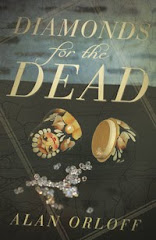
The title of HIDDEN FACETS (my original title) was changed to DIAMONDS FOR THE DEAD. Verdict: much better.

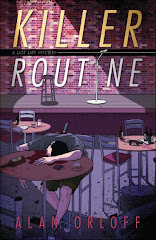
The title of THE LAST LAFF (my original title) has been changed to KILLER ROUTINE - A Last Laff Mystery. Verdict: much better.

Like I said, change can be a very GOOD thing.

(This entry is “simul-posted" on InkSpot.)


Share/Save/Bookmark

Wednesday, January 20, 2010

Thanks…

…for all the great stories.


RobertBParker


Share/Save/Bookmark

Monday, January 18, 2010

Monday Mish-Mash

If they're not "here" yet, ebooks are definitely knocking on the front door. Loudly. How much of an issue is piracy? Bob Miller of HarperStudio has a few thoughts (by way of Nathan Bransford). 

***crit guide

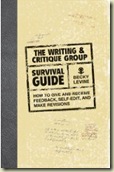
Last Wednesday's post took a few playful jabs at critique groups.   One of the commenters, Becky Levine, knows a thing or two (or two hundred) about them. In fact, she wrote the book on critique groups! It’s called, appropriately enough, The Writing & Critique Group Survival Guide. Check it out here. Hope you had a great launch day, Becky!

***

Because I'll be attending the Malice Domestic conference, I get to complete an Agatha Awards Nomination Form. So many great books to choose from, so few lines on the form!

***

edamame I'm digging my new food for 2010, edamame. Sorry, fennel! Maybe next year.


Share/Save/Bookmark

Friday, January 15, 2010

The Name’s Hayes. Channing Hayes.

Right now, I'm compiling the "bible" for my Channing Hayes series. (The first book, THE LAST LAFF, is complete, and I've started outlining the sequel.)

file folder1 As part of the process, I'm putting together a "dossier" for all the characters--their habits, their histories, their fears and dreams, their favorite breakfast cereal. And what they look like. That's a tough area for me. You see, I'm not one who needs to know every detail about a character's physical description. I don't particularly like reading it, and I don't particularly like writing it. I prefer to keep it short and let the reader fill in the blanks.

Here are a few examples:

Wispy hair swirled on the skinny guy’s head like a soft-serve ice cream cone, and the pupils of his eyes seemed to move independently of each other. Woody Allen had nothing on this guy in the nebbish department.

And:

Ty stood six-six and weighed two-seventy-five, with an androgynously beautiful face perched atop a body carved from a single slab of ebony granite. No seams or cracks anywhere. He looked like he’d started lifting weights when he was seven and hadn’t stopped.

And:

Dressed in a flowing red and silver caftan, with her sultry complexion and dark flowing hair, Erin reminded me of some exotic Persian princess. She invited me in, only to break the fairy tale illusion when she blew a pink bubble-gum bubble and popped it on her lips.

How about you? Are you a MORE or a LESS person when it comes to a character's physical description?


Share/Save/Bookmark